
Are you planning to appear for the GATE Life Science paper?
Many students feel confused about the pattern.
They do not know:
- How many sections are there?
- How marks are divided?
- Is there negative marking?
- How to choose optional subjects?
This detailed guide will explain the GATE Life Science exam pattern in very simple English.
By the end, you will clearly understand how the exam works and how to prepare smartly.
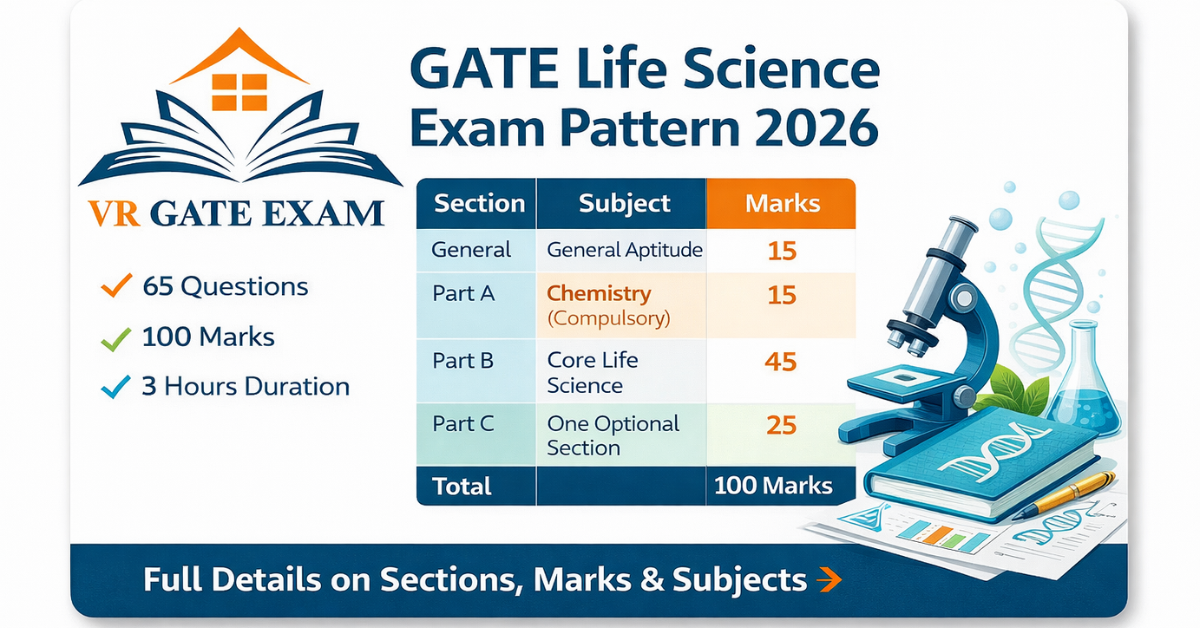
The GATE Life Science exam (XL paper) has 65 questions for 100 marks. It includes General Aptitude (15 marks), Core Life Science subjects (Part A & B – 60 marks), and one optional section (25 marks). The exam duration is 3 hours. Negative marking applies for MCQs only.
What is GATE Life Science?
The GATE Life Science paper is also called XL paper.
It is conducted under the Graduate Aptitude Test in Engineering (GATE) by the Indian Institute of Science and Indian Institutes of Technology.
This paper is for students from:
- Biotechnology
- Microbiology
- Botany
- Zoology
- Biochemistry
- Life Sciences
It helps students get:
- M.Sc / M.Tech admission
- PhD opportunities
- Research fellowships
- PSU jobs (limited fields)
GATE Life Science Exam Pattern 2026 – Overview
Let us first understand the complete structure in one table.
| Section | Subject | Marks |
|---|---|---|
| General Aptitude | Common for all papers | 15 |
| Part A | Chemistry (Compulsory) | 15 |
| Part B | Core Life Science | 45 |
| Part C | One Optional Section | 25 |
| Total | — | 100 Marks |
Total Questions: 65
Total Time: 3 Hours
Mode: Computer Based Test (CBT)
Detailed Section Wise Explanation
1️⃣ General Aptitude (15 Marks)
This section is common for all GATE papers.
Topics include:
- Verbal Ability
- Quantitative Aptitude
- Logical Reasoning
It contains:
- 5 questions of 1 mark
- 5 questions of 2 marks
This section is scoring if prepared well.
2️⃣ Part A – Chemistry (Compulsory – 15 Marks)
This section is mandatory.
It tests basic chemistry knowledge needed in life sciences.
Topics include:
- Organic Chemistry
- Physical Chemistry
- Inorganic Chemistry
Even if you are from Zoology or Botany, you must attempt this section.
3️⃣ Part B – Core Life Science (45 Marks)
This is the main section.
It includes:
- Biochemistry
- Molecular Biology
- Cell Biology
- Genetics
- Ecology
- Plant & Animal Physiology
This section carries the highest weightage.
So focus more here.
4️⃣ Part C – Optional Section (25 Marks)
You must choose one optional subject from the given list.
Optional subjects available:
- Microbiology
- Biochemistry
- Botany
- Zoology
- Food Technology
Choose based on your graduation background.
Types of Questions in GATE Life Science
There are three types of questions:
1. MCQs (Multiple Choice Questions)
- 4 options
- Only one correct
- Negative marking applies
2. MSQs (Multiple Select Questions)
- More than one correct option
- No negative marking
3. NAT (Numerical Answer Type)
- Answer is numerical value
- No options given
- No negative marking
Negative Marking Rules
Understanding negative marking is very important.
| Question Type | Negative Marking |
|---|---|
| 1 Mark MCQ | -0.33 |
| 2 Mark MCQ | -0.66 |
| MSQ | No negative marking |
| NAT | No negative marking |
So avoid guessing in MCQs.
Marking Scheme Explained
Total marks = 100
- 1 mark questions
- 2 mark questions
Marks are added for correct answers.
Wrong MCQs reduce marks.
MSQ and NAT are safer.
Subject Wise Weightage (Approximate Trend)
Based on previous years analysis:
| Subject | Approx Weightage |
|---|---|
| General Aptitude | 15% |
| Chemistry | 15% |
| Core Life Science | 45% |
| Optional | 25% |
Core subjects matter most.
Comparison with Other GATE Papers
| Feature | GATE Life Science | GATE Engineering Papers |
|---|---|---|
| Sections | 4 | 3 |
| Optional Section | Yes | No |
| Chemistry Compulsory | Yes | No |
| Total Marks | 100 | 100 |
| Duration | 3 Hours | 3 Hours |
Life Science paper is unique due to optional choice.
How to Choose Optional Section?
Choose based on:
✔ Graduation subject
✔ Strongest area
✔ Previous year question comfort
✔ Career goal
Example:
If you want PhD in Microbiology → Choose Microbiology.
Step-by-Step Preparation Strategy
Step 1: Understand Pattern Clearly
Do not start preparation without knowing structure.
Step 2: Analyze Previous 10 Years Papers
Look at question distribution.
Step 3: Strengthen Core Concepts
Focus on:
- Molecular Biology
- Genetics
- Biochemistry
Step 4: Practice NAT Questions
These are safe from negative marking.
Step 5: Attempt Mock Tests
Take full-length test weekly.
Benefits of Clearing GATE Life Science
- Admission in IITs and IISc
- Junior Research Fellowship
- PhD programs
- Research career
- Government stipend (~₹12,400/month)
Institutes like:
- IISc Bangalore
- IIT Bombay
- IIT Delhi
offer life science related programs.
Common Mistakes Students Make
- Ignoring Chemistry section
- Choosing wrong optional
- Not reading question carefully
- Guessing MCQs
- Ignoring time management
Avoid these mistakes.
Pro Preparation Tips
- Make short notes
- Revise weekly
- Focus on diagrams
- Practice conceptual questions
- Improve accuracy
Accuracy is more important than speed.
Useful Tools & Resources
- Official GATE website
- Previous year question books
- Online mock tests
- Virtual calculator practice
- Subject-specific standard textbooks
Read Also:
- GATE Life Science Syllabus
- GATE Cut Off 2026
- Best Books for GATE Life Science
- GATE Score vs Rank
FAQs – GATE Life Science Exam Pattern
Q1. How many sections are there in GATE Life Science?
There are four sections: General Aptitude, Chemistry, Core Life Science, and one Optional section.
Q2. Is Chemistry compulsory in GATE Life Science?
Yes. Chemistry (Part A) is mandatory for all candidates.
Q3. Is there negative marking in GATE XL?
Yes, only for MCQs. No negative marking for MSQ and NAT.
Q4. How many questions are there in GATE Life Science?
There are 65 questions for 100 marks.
Q5. How much time is given for GATE XL?
The exam duration is 3 hours.
Q6. Can I choose more than one optional subject?
No. You must select only one optional section.
Final Conclusion
Understanding the GATE Life Science exam pattern is the first step toward success.
If you clearly know:
- Section structure
- Marking scheme
- Optional selection
- Negative marking rules
You can build a strong strategy.
Do not just study hard.
Study smart.
Analyze the pattern.
Practice regularly.
Focus on accuracy.
Start your preparation today with a clear plan.
All the best for GATE 2026 🚀